The crypto regulatory landscape is experiencing significant changes at a remarkable pace, providing unique opportunities and challenges for traditional financial institutions. Despite market volatility, institutional adoption of crypto continues to steadily increase with major banks, asset managers and financial services firms beginning to expand their crypto offerings to meet growing demand.
Against this backdrop of industry momentum, the regulatory landscape has been undergoing significant transformation as well. Staff Accounting Bulletin (SAB) 121, issued in March 2022 by the U.S. Securities and Exchange Commission (SEC), established account guidelines which created barriers for many institutions looking to enter the space. However a pivotal development in December 2024, rescinded these requirements with the introduction of SAB 122, providing banks and broker-dealers with a clearer pathway to develop compliant crypto offerings without the accounting constraints.
Understanding SAB 121
SAB 121 was introduced as a response to the increasing number of institutions beginning to custody crypto assets. This imposed substantial accounting requirements on entities looking to safeguard crypto assets due to the perceived technological, legal and regulatory risks associated with holding these assets. The SEC’s guidance included requiring institutions to:
-
Recognize a liability on balance sheets equal to the fair value of the crypto assets being held
-
Recognize a corresponding asset reflecting the obligation to the asset holders
-
Provide fair value measurement of these assets and liabilities in each reporting period
-
Provide extensive risk disclosures related to crypto asset safeguarding
By requiring firms to hold crypto assets on their balance sheets, SAB 121 created capital inefficiencies that made institutional crypto services prohibitive. However, with the introduction of SAB 122, the regulatory landscape is shifting, creating new opportunities for traditional financial institutions to enter the crypto space.
What Changed with SAB 122?
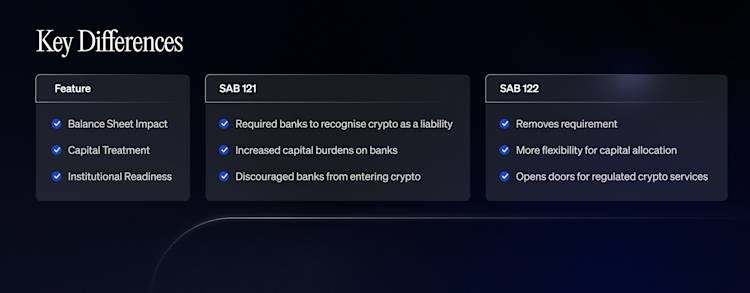
SAB 122, released in December 2024, effectively rescinded SAB 121 and its requirements, marking a significant, more pragmatic shift in regulatory approach. While SAB 122 doesn’t eliminate all regulatory challenges, it reduces the capital constraints that banks previously faced, making it feasible to offer digital asset services without major balance sheet repercussions.
Key Differences:
What This Means for Banks and Broker-Dealers
Banks and broker-dealers have long been cautious about crypto due to the regulatory uncertainty and balance sheet concerns. With SAB 122, traditional financial institutions can now:
-
Face lower barrier to entry for crypto services
-
Offer crypto custody services without excessive balance sheet/capital requirements
-
Expand their services to institutional clients seeking regulated digital asset solutions
As traditional finance and crypto continue to converge, now is the time for banks and broker-dealers to explore their digital asset strategies. While this regulatory shift makes crypto more accessible to these traditional financial institutions, it is still important for institutions to note that crypto custody and services require specialized expertise and trusted infrastructure.
How BitGo Can Help
BitGo stands as the industry’s leading independent qualified custodian, purpose-built for institutional clients. For over a decade, we’ve been at the forefront of building secure, compliant infrastructure for crypto. Our longevity in this space isn’t just a testament to our resilience, it’s evidence of our ongoing commitment to bringing institutional-grade security and regulatory compliance to the industry. BitGo was designed from the ground up to meet the rigorous standards that banks and broker-dealers require. Our custody platform incorporates:
-
Bank-grade security protocols with multi-signature technology
-
SOC 1 Type 2 and SOC 2 Types 2 certifications
-
$250M in insurance coverage(1)
-
BSA/AML compliance frameworks
-
Comprehensive procedures and controls aligned with traditional financial controls
-
Robust API infrastructure that integrates with existing banking systems
BitGo is uniquely positioned at the intersection of traditional finance and technology. Our leadership team brings decades of experience from both Wall Street and Silicon Valley. This dual expertise means we understand both the regulatory realities that banks face and the technological innovations that make crypto powerful.
Let’s build the future together. Connect with us to learn more.
The latest
All News


About BitGo
BitGo is the digital asset infrastructure company, delivering custody, wallets, staking, trading, financing, and settlement services from regulated cold storage. Since our founding in 2013, we have been focused on accelerating the transition of the financial system to a digital asset economy. With a global presence and multiple regulated entities, BitGo serves thousands of institutions, including many of the industry's top brands, exchanges, and platforms, and millions of retail investors worldwide. For more information, visit www.bitgo.com.
©2026 BitGo, Inc. (collectively with its parent, affiliates, and subsidiaries, “BitGo”). All rights reserved. BitGo Bank & Trust, National Association (“BitGo Bank & Trust”) is a national trust bank chartered and regulated by the Office of the Comptroller of the Currency (OCC). BitGo Bank & Trust is a wholly-owned subsidiary of BitGo Holdings, Inc., a Delaware corporation headquartered in Palo Alto, California. Other BitGo entities include BitGo, Inc. and BitGo Prime LLC, each of which is a separately operated affiliate of BitGo Bank & Trust.
BitGo does not offer legal, tax, accounting, or investment advisory services. The information contained herein is for informational and marketing purposes only and should not be construed as legal, tax, or investment advice. You should consult with your own legal, tax, and investment advisor for questions about your specific circumstances.
Digital assets are subject to a high degree of risk, including the possible loss of the entire principal amount invested. Past performance and illustrative examples do not guarantee future results. The value of digital assets can fluctuate significantly and may become worthless. No BitGo communication is intended to imply that any digital asset services are low-risk or risk-free. BitGo is not a registered broker-dealer and is not a member of the Securities Investor Protection Corporation (“SIPC”) or the Financial Industry Regulatory Authority (“FINRA”). Digital assets held in custody are not guaranteed by BitGo and are not subject to the insurance protections of the Federal Deposit Insurance Corporation (“FDIC”) or SIPC. Custody and other digital asset services are subject to eligibility, jurisdictional, and regulatory restrictions. Availability of specific products and services may vary by location and entity.
BitGo endeavors to provide accurate information on its websites, press releases, blogs, and presentations, but cannot guarantee all content is correct, completed, or updated. Content is subject to change without notice. BitGo disclaims any obligation to update or supplement such information except as required by applicable law or regulation.
BitGo makes no representation that the information contained herein is appropriate for use in any jurisdiction where its distribution or use would be contrary to law or regulation or would subject BitGo or any of its affiliates to any registration or licensing requirements in such jurisdiction. Persons who access this information are responsible for complying with all applicable laws and regulations.